

If you work in commercial real estate — or invest in it, develop it, lend against it, or simply
follow the market — you already know that the last eighteen months have been anything but
predictable. Between tariff whiplash, a Supreme Court ruling that shook trade policy,
shifting interest rate expectations, and an AI boom reshaping entire asset classes, the CRE
landscape entering the second quarter of 2026 looks vastly different from where we stood
even a year ago.
But here’s the headline worth paying attention to: commercial real estate is
stabilizing, and in many sectors, it’s accelerating.
Let me break down what’s happening across the national market right now and where the
sharpest opportunities — and risks — are emerging.
The Bottom Line
After a prolonged period of caution, transaction activity is picking back up. CBRE projects
that U.S. commercial real estate investment will rise roughly 16% in 2026 to approximately
$562 billion, approaching pre-pandemic annual averages. Colliers has been even more
bullish, forecasting a 15–20% jump in sales volume as institutional and cross-border capital
re-enters the market.
The bid-ask spread that froze so many deals over the past two years has narrowed
meaningfully. Pricing has found a floor, and for the first time since the rate-hiking cycle
began, there’s genuine confidence that we’re past peak uncertainty. The tone has shifted:
capital is flowing, interest rates are trending lower, and leasing fundamentals are either
stabilizing or improving across most sectors.
That said, this isn’t 2021-era exuberance. Investors are more disciplined. Asset selection and
management are the differentiators now — not just location or leverage.
The Bottom Line
The February Supreme Court decision striking down the IEEPA-based reciprocal tariffs was
one of the biggest stories of 2026 so far. While the ruling initially sparked optimism, the
reality has been more nuanced. The administration moved quickly to signal it would pursue
tariffs through alternative statutory authorities, and steel and aluminum duties remain
firmly in place.
For CRE specifically, tariffs have had a real but contained impact. Structural steel prices
have climbed roughly 23% since mid-2025, and lead times have doubled. Building materials
overall remain more than 40% above early-2020 levels. But many in the industry note that
the actual tariff costs landed in the low single digits as a percentage of total project budgets
— far less dramatic than the initial fear suggested.
The bigger cost driver? Immigration policy. Reduced labor supply in construction trades has
pushed wages higher and stretched timelines — a pressure point that’s proving harder to
manage than materials costs alone.
The Bottom Line
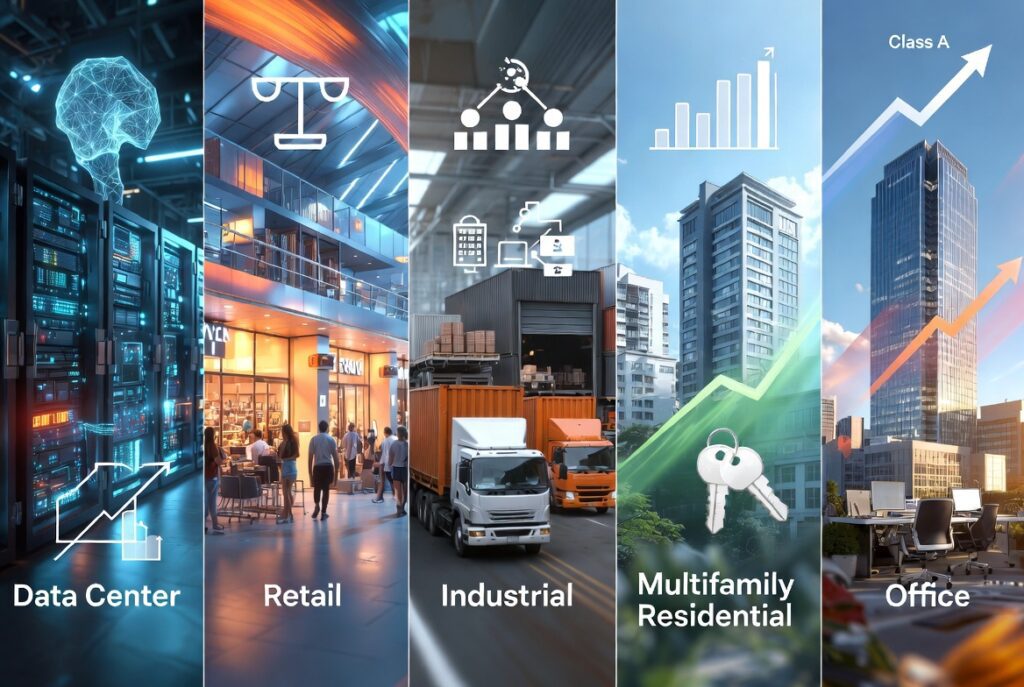
Data Centers remain the undisputed star of this cycle. Demand driven by AI workloads
continues to outpace supply dramatically, with some major global markets reporting 100%
pre-leasing on new construction. Revenue growth projections hover around 7% CAGR. But
headwinds are real: grid capacity constraints, zoning pushback from local communities, and
financing complexity are causing some projects to stall or get shelved entirely.
Retail is enjoying its strongest run in a decade. Grocery-anchored centers and
neighborhood shopping are performing especially well, buoyed by limited new supply and
resilient consumer spending. Valuations across active shopping centers (excluding regional
malls) are at levels we haven’t seen in years.
Industrial is normalizing after its post-pandemic supply surge, but the sector remains
fundamentally sound. The ongoing reconfiguration of global supply chains — accelerated by
trade policy uncertainty — is creating selective opportunities, particularly in logistics hubs
and nearshoring-adjacent markets.
Multifamily continues to lead investment sales volume, though rents are easing in markets
flooded with new supply. The pipeline is moderating, which should bring the sector closer to
equilibrium by late 2026. The wildcard here is immigration: any sustained reduction in
migration flows could soften demand more than expected.
Office is the most bifurcated story in CRE. High-quality, newer buildings in strong
submarkets are thriving — Charlotte, for example, has absorbed more new Class A office space since 2022 than any other U.S. city. Meanwhile, older secondary product continues to
struggle, and the gap between “prime” and “everything else” is widening. Return-to-office
momentum is real but uneven, and AI-driven job displacement adds a layer of uncertainty
that didn’t exist two years ago
The Bottom Line
Beyond data centers, AI is reshaping CRE in subtler ways that deserve more attention. On
the operations side, proptech platforms and AI-powered tools are transforming leasing,
expense management, cash flow modeling, and building performance monitoring. Adoption
is still early, but acceleration in 2026 looks inevitable.
On the demand side, the picture is more complicated. AI-related job displacement —
estimates range widely but are conservatively in the tens of thousands over the past 18
months — is quietly reducing office demand in certain white-collar markets. At the same
time, AI-linked employment growth tends to concentrate in specific metros, creating
localized demand that benefits some markets at the expense of others. This divergence will
only intensify.
The Bottom Line
With commercial mortgage rates still hovering between 6% and 7.5% and a wall of loan
maturities working through the system, distressed properties remain a significant feature of
the 2026 landscape. Inflation has come down to roughly 2.4%, and unemployment sits at
about 4.3% — stable but not exactly stimulative for troubled assets.
For opportunistic investors, this is fertile ground. But success requires deep market
knowledge and operational capability. The days of buying distressed, riding the rate cycle
down, and flipping are over. Value creation in this environment comes from repositioning,
active management, and a clear-eyed understanding of where demand is actually heading.
The Bottom Line
They’re prioritizing asset optimization over acquisition volume — squeezing more value out
of what they already own through repositioning, tenant experience improvements, and
technology upgrades.
They’re designing for flexibility. Mixed-use, adaptive layouts, and infrastructure
readiness for evolving tenant needs are no longer nice-to-haves; they’re requirements.
They’re thinking beyond real estate fundamentals to external pressures — labor
availability, power infrastructure, regulatory risk, and local political dynamics — that
increasingly shape location and investment decisions.
And they’re moving with conviction. In a market where pricing presents genuine
opportunities but competition for quality assets is intensifying, indecision is the biggest risk
of all
The Bottom Line
Commercial real estate in 2026 is neither the doom story some predicted nor a return to the
frothy conditions of a few years ago. It’s a market that rewards strategy over speculation,
precision over broad strokes, and operators who understand that the playbook has
fundamentally changed.
The macro picture is cautiously positive. Sectors are diverging sharply. Capital is returning
but selectively. And technology — especially AI — is simultaneously creating the hottest
asset class in a generation while quietly undermining demand in others.
For those willing to do the work, think clearly about risk, and stay nimble in the face of
ongoing policy uncertainty, 2026 is shaping up to be one of the most interesting — and
potentially rewarding — years in commercial real estate in a long timeWhat are you seeing in your local market? I’d love to hear how these national trends are
playing out on the ground. Drop a comment below.